
CES 2026 in Las Vegas once again proved to be the ultimate stage for display innovation. MicroLED, long hailed as the future of TVs, dominated the show floor with promises of perfect blacks, unmatched contrast, and incredible color purity.
Unlike OLED, MicroLED uses tiny inorganic LEDs that can turn on or off individually. This gives it the same pixel-level control that made OLED revolutionary, without the risk of burn-in or long-term degradation.
The technology is thin, emissive, and architecturally sleek, making panels appear almost like art on the wall.
In theory, MicroLED could finally deliver a living room experience with deep blacks, vivid colors, and ultra-bright highlights. In practice, CES 2026 also highlighted why “ready for home use” is still a distant goal.
Curious to see how MicroLED stacks up against OLED and MiniLED, and what hurdles remain before it lands in your living room? Dive deeper and explore the full story.
How does MicroLED differ from OLED and MiniLED?
OLED has long been the benchmark for perfect blacks because each organic pixel emits its own light. That allows individual pixels to switch off completely, giving infinite contrast ratios.
MicroLED achieves the same self-emissive effect using inorganic LEDs, which are more durable and can maintain performance far longer. Standard OLED panels last between 30,000 and 60,000 hours, whereas MicroLED panels are often projected to exceed 100,000 hours.
This longevity is critical as modern TVs are expected to handle sports tickers, game HUDs, and app interfaces for years without performance loss.
MiniLED, by contrast, still relies on backlighting. It can deliver high brightness and better local dimming, but it cannot achieve the same pixel-level control as OLED or MicroLED.
Unlike standard MiniLEDs, Micro RGB displays like the Samsung R95H and LG MRGB95 are self-emissive, allowing each pixel to turn off completely for perfect blacks and infinite contrast.
Little‑known fact: OLED displays have operational lifespan ranges of roughly 30,000 to 60,000 hours before noticeable brightness degradation appears, a limitation MicroLED aims to overcome.
CES 2026 highlights the color race
At this year’s CES, manufacturers competed to showcase the broadest color gamut and most accurate HDR performance.
While Hisense claims the 163MX can achieve up to 100% of the BT.2020 color space, official CES 2026 Innovation Awards documentation specifies a coverage of 95%.
Samsung showed multiple Micro RGB models from 55 inches up to 130-inch prototypes, all boasting near-perfect color reproduction. LG’s Micro RGB evo lineup also promised over a thousand local dimming zones to refine brightness and color consistency.
These innovations reveal the lengths manufacturers are willing to go for color accuracy. However, the setups are overwhelmingly large, wall-mounted, and professionally installed.
What looks stunning in a trade show environment does not translate easily into a living room with normal furniture, room geometry, and budget constraints.
Size and installation are the real hurdles.
CES 2026 demonstrated that the largest MicroLED panels steal attention. Panels like Samsung’s 130-inch Micro RGB prototype or Hisense’s 163-inch RGBY MicroLED dominate a space the size of a small studio apartment.
These installations require precise alignment, zero-gap mounting, and careful calibration to maintain color uniformity and brightness across the display.
For a typical home, shipping, placement, and serviceability are major obstacles. These panels are heavy, extremely delicate, and complex to maintain over time.
Unlike OLED or MiniLED TVs, which come as complete, single units ready for consumer purchase, large-scale MicroLED remains a modular, professional-only installation.
Little‑known fact: Hisense unveiled three major new display technologies at CES 2026, including RGB mini‑LED, RGB mini‑LED Evo (with a cyan subpixel), and RGBY MicroLED to broaden color gamut and enhance brightness at scale.
Brightness vs. consistency
One of MicroLED’s biggest advantages is peak brightness. Many OLED TVs are still below MicroLED and bright LCDs in full-screen brightness, but by 2026, some OLED highlights will exceed 4,000 nits in small-window measurements.
Maintaining color accuracy, uniformity, and thermal stability at high brightness over extended periods is far more challenging.
Trade show demos often exaggerate brightness with controlled lighting and short video loops. In real living rooms, with ambient light and long viewing sessions, MicroLED panels may struggle to maintain consistency without visible artifacts. This is where OLED remains a practical choice for everyday use.
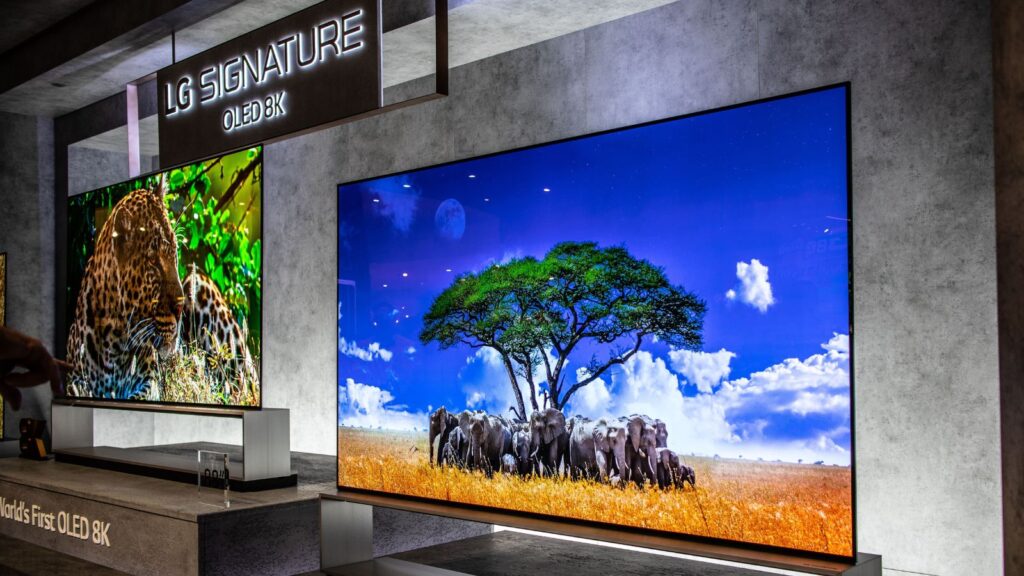
Micro RGB versus MicroLED
While MicroLED remains self-emissive, Micro RGB or RGB MiniLED TVs rely on advanced LED arrays behind a liquid crystal layer. Samsung’s MR95F Micro RGB TV and LG’s Micro RGB evo deliver remarkable color volume and near-complete BT.2020 coverage.
The difference is that these TVs cannot turn pixels off individually. Contrast falls short of OLED or MicroLED, even as brightness and color accuracy improve. Micro RGB TVs are also more attainable than full MicroLED installations.
Hisense has positioned its RGB MiniLED TVs as a value alternative with respectable color reproduction and higher accessibility for consumers. Samsung and LG remain premium options, with prices in the tens of thousands for large displays.
The current state of consumer readiness
Despite the eye-catching demos at CES, MicroLED is not yet ready for most homes. The panels are massive, modular, and require professional setup.
The high cost of these brands makes them inaccessible to the average consumer.
Samsung currently lists The Wall All-in-One at $70,000 for 110-inch 2K, $92,000 for 146-inch 2K, and $219,999 for 146-inch 4K. Samsung’s 89-inch residential Micro LED has been listed at $109,999.
In comparison, OLED, QD-OLED, and Micro RGB TVs offer a more practical package. They provide excellent contrast, impressive color, and are compatible with standard living room setups.
For those seeking perfect blacks and cinematic contrast today, OLED still represents the best balance of performance, cost, and accessibility.
The path forward
MicroLED will continue to evolve, with CES serving as a proving ground for innovations. Engineers are working on reducing module size, improving thermal management, and simplifying installation. There is also a focus on bringing costs down to levels comparable to high-end OLEDs.
The promise of the technology is compelling: perfect blacks, nearly limitless brightness, durability, and color accuracy.
Once MicroLED can be produced in consumer-friendly sizes with simpler installation, it could finally become a living room staple. Until then, it remains an exciting, albeit aspirational, technology.
Why CES matters for display technology
CES allows manufacturers to demonstrate what is possible when cost and logistics are not constraints. MicroLED’s dominance at the show is a reminder of the future potential, even if the present reality is limited.
The competition between Micro RGB, OLED, and MicroLED is accelerating innovation, and each year brings incremental improvements in color volume, brightness, and panel durability.
For consumers, CES 2026 confirms that perfect blacks and incredible color are achievable, but not yet practical. Enthusiasts may dream of the day when MicroLED fits a standard living room, but for now, the technology remains a luxury showcase for exhibition halls and ultra-premium setups.
TL;DR
- MicroLED offers perfect blacks and long-lasting panels without burn-in.
- CES 2026 highlighted incredible color, high brightness, and massive display prototypes.
- Micro RGB or RGB MiniLED TVs improve color but cannot achieve pixel-level blacks.
- Installation, size, and cost make MicroLED impractical for most living rooms.
- OLED and QD-OLED remain practical options for consumers today.
- Manufacturers are experimenting with color gamuts, thermal management, and modular designs.
- Hisense, Samsung, and LG are leading MicroLED and Micro RGB innovation.
- Peak brightness is impressive, but consistency over time is the true challenge.
- Consumer-ready MicroLED is likely years away despite CES showfloor excitement.
- CES demonstrates the future potential, pushing the entire display industry forward.
This article was made with AI assistance and human editing.
If you liked this, you might also like:
Trending Products

iRobot Roomba Plus 405 (G181) 2in1 ...

Tipdiy Robot Vacuum and Mop Combo,4...

iRobot Roomba 104 2in1 Vacuum &...

Tikom Robot Vacuum and Mop Cleaner ...

ILIFE Robot Vacuum

T2280+T2108

ILIFE V5s Pro Robot Vacuum and Mop ...

T2353111-T2126121

Lefant Robot Vacuum Cleaner M210, W...