
For years, Apple enthusiasts and tech watchers have speculated about the company’s move into augmented reality (AR) glasses. Rumors, leaks, and patent filings have hinted at a future where Apple could transform how digital content is experienced, placing notifications, navigation, and immersive apps directly in front of users’ eyes.
Yet, the wait may be longer than anticipated. According to a fresh market forecast from research firm Omdia, Apple’s high-end AR smart glasses with integrated displays may not arrive until 2028.
This projection reflects Apple’s deliberate approach to hardware development. Unlike competitors rushing to bring AR and mixed-reality devices to market, the company seems willing to wait, prioritizing display quality, battery efficiency, and a seamless iPhone ecosystem integration over speed.
While this patience may frustrate fans, it follows Apple’s historical strategy of launching later but with refined, highly polished products. Dive deeper to discover what this timeline means for Apple, its competitors, and the future of AR smart glasses.
Two paths for Apple glasses
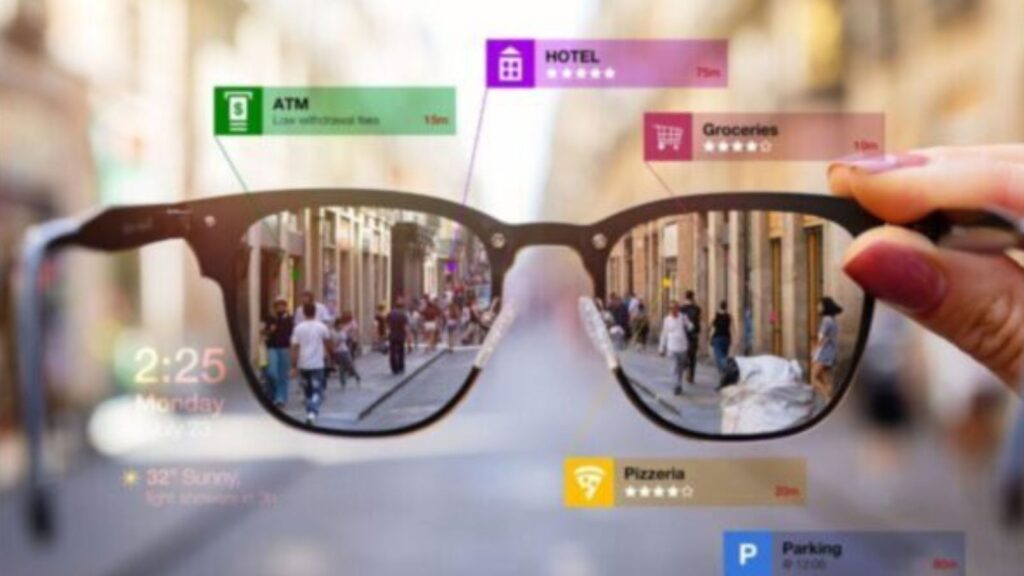
According to multiple reports, Apple is developing two distinct pairs of smart glasses. The first is expected to be a simpler model designed to rival existing Meta Ray-Ban smart glasses and Snap Spectacles. This device may focus on lightweight wearability, AI-powered camera features, and basic augmented-reality functions without a built-in display.
The second model is far more ambitious. This AR variant is rumored to include dual OLEDoS (OLED on silicon) displays for each lens, a technology already used in Apple’s Vision Pro headset. OLEDoS is tailored for compact, near-eye devices. Placing the light-emitting layer directly onto a silicon wafer allows for significantly higher pixel density than traditional OLED panels.
The result is crystal-clear imagery in a very small footprint, critical for AR glasses where displays sit just inches from the user’s eyes.
Reports suggest these high-end AR glasses may be launched after Meta releases its own advanced AR eyewear, likely in 2027. Apple appears to be following a cautious timeline to ensure the displays meet the company’s exacting standards.
The OLEDoS advantage
OLEDoS is a display innovation that provides higher pixel density, lower power consumption, and a thinner form factor than older TFT LCD or LCoS (Liquid Crystal on Silicon) technologies.
These factors are essential for wearable devices. In AR applications, sharpness and clarity directly affect usability and comfort. Blurry or pixelated visuals can cause eye strain over prolonged use.
At this year’s CES, Samsung demonstrated the potential of OLEDoS with a 1.4-inch RGB prototype boasting 5,000 PPI. This demonstrates what Apple and other companies could achieve in next-generation AR wearables.
While Apple is taking its time, other brands are already pushing ahead. Meta is expected to launch lightweight MR headsets using OLEDoS displays and pancake lenses, and brands like Asus and RayNeo are planning AR/MR glasses based on Micro-OLED/OLEDoS-class panels with high refresh rates and compact optics. Exact panel sizes (such as “0.9-inch”) remain unconfirmed.
Patience as a strategic move
Apple’s projected 2028 launch window suggests the company is deliberately waiting for technology and market conditions to mature. While competitors introduce their first OLEDoS-equipped AR devices as early as 2026 or 2027, Apple is focusing on a polished experience rather than being first to market.
This approach aligns with Apple’s historical strategy. By entering emerging tech markets after early movers, Apple can learn from competitors’ successes and missteps, avoid early-stage pitfalls, and deliver a device that feels refined, reliable, and worth the premium price.
A bridge until 2028: the N50 frames
While true AR glasses may still be years away, Apple is not leaving consumers empty-handed. Bloomberg reporter Mark Gurman recently shared details about the N50, a pair of display-less AI camera glasses slated for potential release in late 2026.
Unlike the full AR glasses, the N50 would rely on cameras and microphones to augment user interactions with Siri.
This setup could allow real-time environmental analysis, contextual audio feedback, and AI-driven recommendations based on what the user sees. Essentially, the N50 acts as a bridge between current smart eyewear and the full AR vision Apple is planning.
Reports suggest Apple aims to begin trial production of its AI glasses around the latter half of 2026, with internal testing underway, but no specific production month or mass-production date has been confirmed.
While these glasses will not project digital content directly onto the lenses, they represent Apple’s first tangible move into smart glasses that extend beyond standard audio or fitness wearables.
Little‑known fact: Apple’s team is reportedly working on a custom chip specifically designed for future smart glasses, derived from an Apple Watch chip but optimized for multiple cameras and sensors.
AR glasses competition heating up
Apple is not the only company betting on OLEDoS. Meta, Samsung, Asus, and RayNeo are all embracing the technology, which is becoming the standard for high-resolution near-eye displays. This convergence is fueling an emerging ecosystem of OLEDoS-based AR and MR devices.
Meta is expected to launch its next-generation MR glasses within the next year, allowing Apple to observe performance and consumer reception before committing fully to production. Samsung and Asus prototypes indicate display quality and refresh rates are climbing to impressive levels, making the competition even stiffer.
OLEDoS’s rise is not just about resolution. Its reduced power consumption and the ability to create thinner, lighter glasses are critical to user comfort, a major barrier to adoption. The display wars of the next few years will likely center on OLEDoS performance, AI integration, and battery optimization.
Technical hurdles and market realities
Despite Apple’s experience with displays and consumer hardware, OLEDoS remains challenging to manufacture at scale. Producing panels with extremely high pixel densities while keeping power draw and heat generation low is not trivial. Any shortcuts could compromise visual quality or usability.
This is likely a major reason for Apple’s cautious timeline. By waiting until 2028, the company can ensure its AR glasses deliver not just high-end visuals but also a polished, comfortable, and reliable experience that aligns with the Apple brand.
Meanwhile, the market is expected to mature further. Analysts forecast that AR, VR, and MR revenue could reach $1.2 billion by the end of 2026, driven in part by increasing adoption of OLEDoS in consumer devices.
Apple will be entering a market with established competitors, but its strategy suggests the company will do so with a product refined enough to make a strong impression.
What to expect from Apple’s AR glasses
Apple’s AR glasses roadmap reflects the company’s long-term strategic thinking. Display-less AI frames may arrive as early as 2026, but the true AR experience with dual OLEDoS displays capable of projecting crisp digital content is at least two years away.
The delay allows Apple to refine software, optimize battery performance, and perfect integration with VisionOS and the iPhone ecosystem.
By the time the glasses are released, they are expected to represent a carefully crafted, polished step forward in wearable technology, with clarity, performance, and design that could set a benchmark in the market.

TL;DR
- Apple’s AR smart glasses may not arrive until 2028. The company is reportedly developing two models: a simpler, display-less version designed to rival Meta Ray-Ban smart glasses and Snap Spectacles, and a high-end AR model with dual OLEDoS displays.
- OLEDoS offers high pixel density, low power consumption, and thin form factors, essential for wearable AR.
- While competitors such as Meta, Asus, and Samsung are showing OLEDoS-equipped devices as early as 2026, Apple is taking a cautious approach to ensure display clarity, battery efficiency, and seamless iPhone integration.
- In the meantime, Apple may release the N50 AI camera glasses in late 2026. This model will not project visuals but will provide AI-assisted contextual experiences through cameras and microphones.
- The 2028 AR glasses are expected to combine these innovations into a polished, high-end device that could redefine smart eyewear.
This article was made with AI assistance and human editing.
If you liked this, you might also like:
.
Trending Products

iRobot Roomba Plus 405 (G181) 2in1 ...

Tipdiy Robot Vacuum and Mop Combo,4...

iRobot Roomba 104 2in1 Vacuum &...

Tikom Robot Vacuum and Mop Cleaner ...

ILIFE Robot Vacuum

T2280+T2108

ILIFE V5s Pro Robot Vacuum and Mop ...

T2353111-T2126121

Lefant Robot Vacuum Cleaner M210, W...