
Apple’s first foldable iPhone arrives with a $1,999 starting price, but its biggest change may be how buyers think about an iPhone. The iPhone Duo combines a conventional phone, compact tablet and productivity device into one folding design.
The Duo opens into a 7.6-inch display built for multitasking, video, gaming and documents. It also introduces fold-specific camera features, Apple Pencil support and software designed around different screen positions, while making several compromises compared with Apple’s Pro models.
For smart-home enthusiasts, the larger display could turn the Duo into a portable control surface for cameras, locks, lighting and automation dashboards. However, its appeal depends heavily on whether the foldable workflow justifies its substantial premium.
A premium price changes expectations
The iPhone Duo starts at $1,999 with 256GB of storage in the United States. Apple also offers 512GB, 1TB and 2TB configurations priced at $2,199, $2,599 and $3,199, respectively.
Preorders begin Oct. 16, with availability scheduled for Oct. 23 across more than 70 countries and regions. Apple says the Duo will reach another 28 countries and regions on Oct. 30, making it a broad international launch.
The starting price is $700 higher than the $1,299 iPhone 18 Pro Max. It is about $100 less than Samsung’s $2,099.99 Galaxy Z Fold8, placing the Duo firmly in the premium foldable category.
What changes when the iPhone folds?
The Duo uses a book-style hinge and two OLED displays. Closed, its 5.4-inch outer screen handles conventional phone tasks, while opening the device reveals a 7.6-inch inner display designed for a larger workspace.
The inner screen measures 1,878 by 2,670 pixels and reaches up to 120Hz with adaptive ProMotion. The outer display measures 1,398 by 2,034 pixels, while both panels support Always-On functionality, HDR, True Tone, P3 wide color and Dynamic Island elements.
At 5.2mm open, the Duo is Apple’s thinnest iPhone in that configuration. Folded, however, it measures 11.3mm thick and weighs 254 grams, making it heavier and thicker than some competing foldables.
Durability gets serious attention
Apple says the hinge contains more than 100 components and uses variable torque. It can hold the Duo flat or partially folded, while an integrated magnet array helps keep the device securely closed.
The enclosure combines Grade 5 titanium with Ceramic Shield 2 on the outer display and Ceramic Shield on the rear. The folding panel also uses layered protection, including high-strength glass, custom adhesives and a titanium support plate.
Apple gives the Duo an IP68 rating, with laboratory testing covering submersion to six meters for up to 30 minutes. That does not eliminate concerns about drops, hinge wear, or pressure applied to the folding display.
Face ID makes an unexpected exit
Unlike the iPhone 18 Pro, the Duo uses Touch ID built into its side button. Apple Watch can also help unlock the phone, while an under-display FaceTime camera keeps the inner screen visually uninterrupted when that camera is not being used.
The change means buyers lose one of the familiar biometric features associated with recent iPhones. It also reflects the design challenge of creating a large folding display without requiring a conventional TrueDepth camera system on the inner panel.
The rear cameras also make compromises. The Duo has a 48MP Fusion Main camera and a 48MP Fusion Ultra Wide camera, but there is no dedicated telephoto lens or variable aperture.
Camera features focus on folding
The main camera uses a 26mm-equivalent focal length, an f/1.6 aperture, and sensor-shift optical stabilization. Its 2x optical-quality crop comes from the main sensor, while the ultra-wide camera offers a 13mm-equivalent view and a 120-degree field of view.
The foldable design enables several camera features that depend directly on the two displays. Duo Preview lets subjects check framing, while Smart Take uses on-device AI to capture when people appear ready.
Kid Cue uses animations to attract children toward the camera, while Duo FaceTime lets nearby people participate through the outer screen. Dual Capture can record from front and rear cameras simultaneously.
A20 Pro powers the larger workspace
The Duo uses Apple’s A20 Pro chip, the same processor found in the iPhone 18 Pro models. Apple lists a 6-core CPU, 7-core GPU with Neural Accelerators and a Dual 16-core Neural Engine.
Apple says the A20 Pro is built using a 2-nanometer process and delivers up to 20% faster CPU performance than A19 Pro, up to 40% faster GPU performance and twice the Neural Engine compute power.
A custom vapor chamber helps manage heat inside the thin folding chassis. Apple claims up to 35% better sustained performance than the iPhone 17 Pro, based on its testing.
Little-known fact: The Duo’s M-series-inspired chip package attaches the A20 Pro directly to the vapor chamber.
Battery life depends on screen choice
The Duo contains one high-energy battery on each side of the device. Apple says its silicon and energy-rebalancing systems allow the two batteries to operate seamlessly as one.
Apple rates the Duo for up to 24 hours of usage when the inner and outer displays are used equally. Video playback can reach 44 hours on the outer display or 31 hours on the inner display.
The Duo can charge to 50% in around 20 minutes using wired fast charging. MagSafe and Qi2 wireless charging support up to 25W, while Apple says wireless charging can reach 50% in around 30 minutes.
iOS turns folding into multitasking
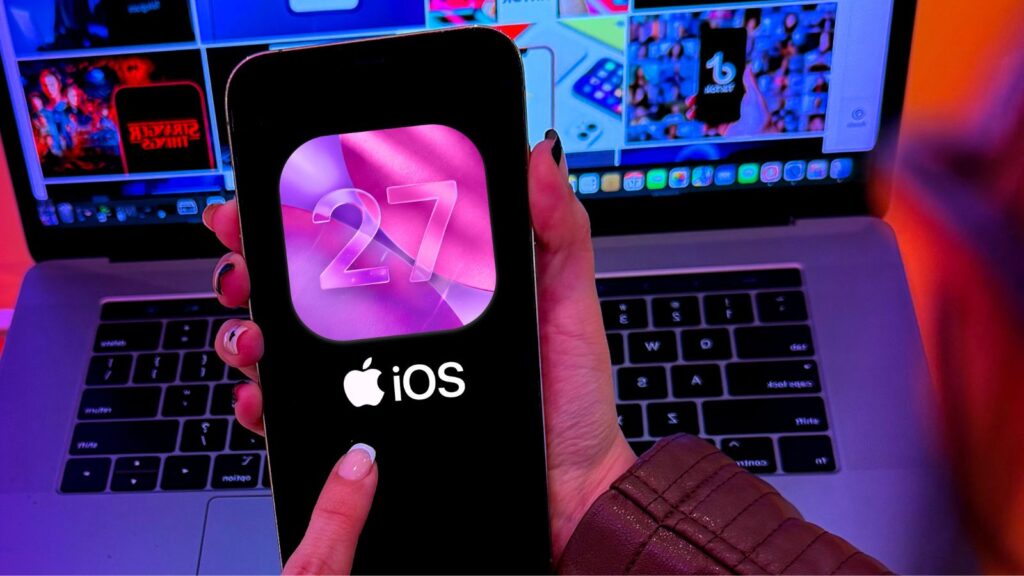
The Duo ships with iOS 27.1, which adapts the interface depending on whether the device is open, closed, partially folded, or rotated. Apple also moves certain navigation elements toward the side to preserve vertical space.
Split View lets users run two apps side by side, while supported apps can open in two separate windows. Saved app pairs provide another shortcut for frequent multitasking combinations.
The device also supports hands-free FaceTime when partially folded, StandBy on either display and layouts that transfer content between the outer and inner screens. Apple Pencil USB-C support is scheduled to arrive later in 2026.
Why the Duo matters for smart homes
A 7.6-inch display gives the Duo more room for home-control interfaces than a conventional iPhone. Users could view a security camera beside Messages, monitor energy information alongside Safari, or keep lighting controls visible while checking another app.
The Duo supports Thread networking, which is relevant to Matter-compatible accessories and Apple Home ecosystems. That connectivity could make the foldable useful as a portable interface for cameras, sensors, locks, lighting and other connected devices.
StandBy adds another possibility. When placed on a desk or counter, the Duo can show widgets, a clock, calendar information, weather, or photos, making the folded device useful beyond ordinary phone interactions.
The trade-offs are impossible to ignore
The Duo offers a larger workspace, two 48MP rear cameras, IP68 water and dust resistance, A20 Pro performance, Apple Pencil support and fold-specific software. Those features give it a different role from a conventional iPhone.
However, buyers give up Face ID, a dedicated telephoto camera and a variable-aperture main camera. The device is also heavier than some competing foldables, while Apple sells its Duo case for $79 and its Folio with Kickstand for $129.
The Duo, therefore, is not simply a larger iPhone 18 Pro. Its value comes from combining a compact phone with a tablet-like workspace rather than maximizing every conventional smartphone specification.
A new category within Apple’s lineup
The iPhone Duo establishes a different upgrade proposition for Apple buyers. Instead of focusing only on faster performance or improved cameras, the device makes screen size and physical flexibility central to the experience.
For smart-home users, that approach could be especially useful because the larger display provides more room for control panels and monitoring tools. Thread support further connects the device with modern smart-home ecosystems.
Still, the Duo makes the most sense for buyers who specifically want its foldable workflow. Its $1,999 starting price, missing telephoto camera, and Touch ID authentication show that Apple is asking customers to value the form factor differently.

TL;DR
- Apple’s iPhone Duo starts at $1,999 and combines a traditional phone with a 7.6-inch tablet-like display for multitasking and productivity.
- The foldable replaces Face ID with Touch ID and skips a dedicated telephoto camera, creating notable differences from Apple’s conventional Pro models.
- Its A20 Pro chip, vapor-chamber cooling, and dual batteries are designed to support demanding workloads across two displays.
- Smart-home users could use the larger inner screen for cameras, lighting, locks, energy dashboards and other connected-home controls.
- The Duo’s strongest justification is its flexible workflow, rather than superior photography, lighter construction, or conventional iPhone value.
This article was made with AI assistance and human editing.
If you liked this, you might also like:
Trending Products

iRobot Roomba Plus 405 (G181) 2in1 ...

Tipdiy Robot Vacuum and Mop Combo,4...

iRobot Roomba 104 2in1 Vacuum &...

Tikom Robot Vacuum and Mop Cleaner ...

ILIFE Robot Vacuum

T2280+T2108

ILIFE V5s Pro Robot Vacuum and Mop ...

T2353111-T2126121

Lefant Robot Vacuum Cleaner M210, W...