
Samsung is making a clear statement in 2026. Big screen gaming is no longer a compromise. With Nvidia G Sync compatibility now built into its latest OLED TVs and select Odyssey monitors, the company is positioning its displays as serious alternatives to traditional gaming monitors.
For years, Nvidia G-Sync was associated mainly with high-end PC monitors. It was the gold standard for eliminating screen tearing and reducing stutter during demanding gameplay.
While some LG TVs adopted the technology as early as 2019, Samsung largely focused on AMD FreeSync support. That changes this year.
Now, every new Samsung OLED TV for 2026 carries Nvidia G-Sync Compatible certification, bringing smoother frame syncing to living room gaming setups.
Read more to see how Samsung OLED TVs with Nvidia G-Sync deliver smooth, tear-free gameplay and stunning big-screen PC gaming experiences.
Why G-Sync matters on a TV
To understand why this is significant, it helps to understand how G-Sync works. When you play a graphically intense game, your PC’s frame rate often fluctuates.
Even if your display supports 120Hz or higher, your graphics card may dip below that during complex scenes. Without variable refresh rate technology, that mismatch causes screen tearing or stutter.
G Sync solves this by synchronizing the TV’s refresh rate with the frames output by your Nvidia GPU. If your frame rate drops, the display adjusts in real time.
The result is smoother motion, fewer visual artifacts, and a noticeably more fluid experience. On a large OLED screen, those improvements are even more visible.
Samsung’s 2026 OLED lineup, including the S85H, S90H, and S95H models unveiled at CES 2026, all support Nvidia G-Sync Compatible.
The S85H reaches refresh rates up to 120Hz, while the S90H and S95H push as high as 165Hz, depending on size. Those numbers put them squarely in gaming monitor territory.
A shift in how we use TVs
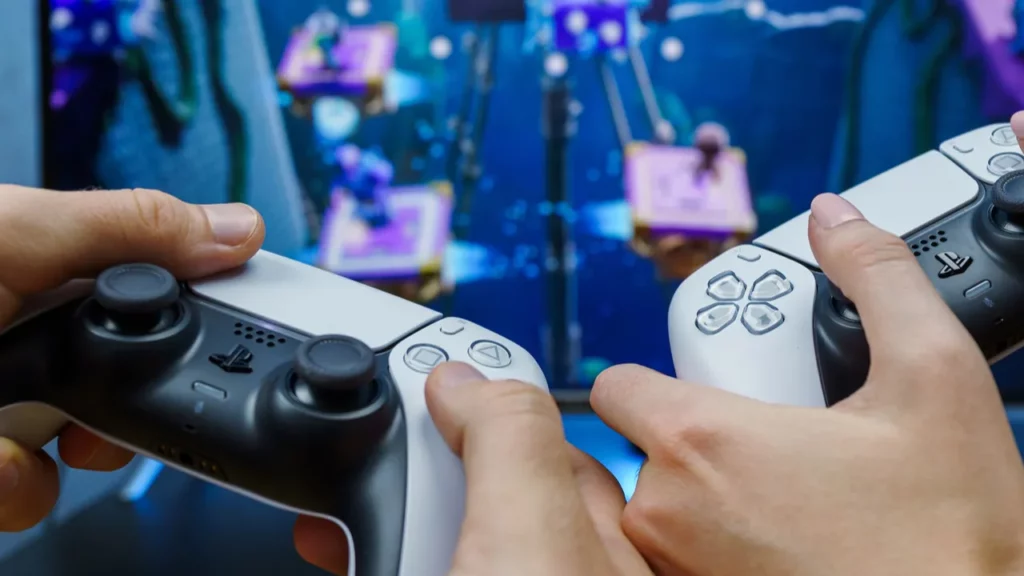
There has always been a subset of PC gamers who connect their desktops to living room TVs. Some use large screens for couch gaming. Others prefer smaller premium TVs as oversized monitors for immersive single-player titles.
That trend is accelerating. Devices like the Steam Deck have made it easier than ever to dock a handheld PC and instantly play on a big screen.
Valve has now announced a new Steam Machine–style living-room PC based on AMD CPUs and GPUs, which could further push PC gaming into the living room. Even though AMD markets its own VRR standard under the FreeSync brand and Nvidia uses G-Sync, Samsung’s 2026 OLED TVs support both G-Sync Compatible and AMD FreeSync Premium Pro.
In addition to Nvidia G-Sync Compatible certification, Samsung’s new OLED TVs also feature AMD FreeSync Premium Pro.
Little‑known fact: Samsung’s 2026 Odyssey G6 (G60H) monitor supports an astounding 1,040 Hz refresh rate in HD mode, a spec far higher than most consumer displays and designed specifically for hyper‑competitive gaming.
That dual support makes them flexible regardless of whether you use an Nvidia or AMD graphics card. For households with multiple gaming devices, that versatility matters.
OLED advantages for PC players
Adding G Sync is only part of the story. OLED technology itself plays a major role in making these TVs attractive for PC gamers.
Unlike traditional LED LCD panels, OLED displays offer self-emissive pixels. Each pixel can turn off completely, delivering true blacks and near infinite contrast.
In practical terms, that means deeper shadows in dark games, more vivid highlights in HDR content, and greater overall image depth. Samsung’s latest OLED TVs also support HDR10+ Advanced and HDR10+ Gaming, enhancing dynamic range during gameplay.
Little‑Known fact: Samsung’s latest OLED panels in 2026 can reach a theoretical peak brightness of up to 4,500 nits under specific test conditions, far higher than typical OLED limits, though the real‑world peak is 2,700 nits. This improves picture punch and HDR performance in bright scenes.
Response time is another critical factor. OLED panels are known for extremely fast pixel transitions. Samsung’s Odyssey OLED G6 monitor, for example, boasts a 0.03ms response time at QHD resolution and refresh rates up to 240Hz.
While TVs may not reach those extreme specs, they still benefit from OLED’s inherent speed, reducing motion blur during fast-paced games.
Odyssey monitors join the party
Samsung is not limiting G Sync support to its televisions. The company’s new Odyssey lineup for 2026 also carries Nvidia G-Sync Compatible certification.
The 27-inch Odyssey G6 G60H can reach an astonishing 600Hz at QHD resolution and even higher at HD resolution.
Meanwhile, the Odyssey OLED G6 G61SH pairs QD OLED technology with a 240Hz refresh rate and HDR10+ Gaming certification. These monitors are clearly aimed at competitive gamers who demand ultra-high frame rates and minimal latency.
Interestingly, the 2026 Odyssey OLED G8 lineup also includes Nvidia G-Sync Compatible support, alongside AMD FreeSync, depending on the specific model.
Even so, the broader message is clear. Whether you choose a living room TV or a desktop monitor, Samsung wants to offer a consistent gaming experience across form factors.
Big screen gaming without compromise
In the past, using a TV for PC gaming often meant sacrificing responsiveness or accepting limited refresh rates. Many TVs capped at 60Hz, introduced input lag, or lacked proper variable refresh rate support.
That gap is closing quickly. With refresh rates reaching 120Hz to 165Hz on OLED TVs and full G-Sync compatibility, Samsung is removing many of the traditional barriers.
For cinematic games like open-world RPGs or racing titles, playing on a 65 or 77-inch OLED screen with synchronized frame rates feels fundamentally different from gaming on a 27-inch monitor.
The sense of scale, combined with smooth motion, creates an experience that feels closer to a private theater than a desk setup.
Kevin Lee, Executive Vice President of Samsung’s Visual Display Business, summed up the company’s goal clearly.
Samsung wants to deliver a consistently great gaming experience, no matter what you play or where you play it. By bridging the gap between monitors and TVs, it is attempting to make that promise tangible.
The competitive landscape
Samsung is not alone in targeting PC gamers. LG has supported G Sync on select OLED TVs for several years. Meanwhile, brands continue to refine Mini LED and QD OLED technologies.
The difference now is that Samsung is committing across its entire 2026 OLED TV lineup rather than limiting the feature to a few premium models.
That broad adoption signals confidence. It suggests Samsung sees PC gaming as a central use case for its TVs, not a niche add-on.
The rise of cross-platform gaming also strengthens this strategy. Many players switch between consoles, PC, and cloud gaming services.
A display that supports both G Sync and FreeSync, offers high refresh rates, and delivers strong HDR performance becomes a future-proof centerpiece for all those devices.
Little‑known fact: The Odyssey G6 (G60H) monitor can hit an astounding 1,040 Hz refresh rate at HD resolution in dual‑mode, a spec almost unheard of in consumer displays.
A new default for living room PCs
Perhaps the most interesting aspect of Samsung’s move is what it says about the future of computing. As powerful GPUs become more common and compact PCs continue to shrink, the idea of a living room gaming rig feels less unusual.
Dockable handhelds, small form factor PCs, and even cloud gaming boxes are blurring the line between console and computer.
In that context, a high-end OLED TV with full variable refresh rate support is no longer just a display for movies and streaming. It becomes the primary screen for both entertainment and interactive experiences.
Samsung’s addition of Nvidia G-Sync compatibility does not reinvent the TV. But it does eliminate one of the last technical hurdles for serious PC gamers considering a large OLED screen.
Combined with fast refresh rates, HDR support, and the inherent strengths of OLED panels, the result is a display that can genuinely make big-screen PC gaming feel flawless.
For players who have been waiting for a reason to move their rig from the desk to the couch, this might finally be it.
This article was made with AI assistance and human editing.
If you liked this, you might also like:
Trending Products

iRobot Roomba Plus 405 (G181) 2in1 ...

Tipdiy Robot Vacuum and Mop Combo,4...

iRobot Roomba 104 2in1 Vacuum &...

Tikom Robot Vacuum and Mop Cleaner ...

ILIFE Robot Vacuum

T2280+T2108

ILIFE V5s Pro Robot Vacuum and Mop ...

T2353111-T2126121

Lefant Robot Vacuum Cleaner M210, W...