
You’ve probably seen the ads. “OLED TV, now on sale.” Big discounts splashed across Black Friday banners, Super Bowl promos, and year-end clearance events.
Yet every time you check the price tag, the same reality hits: OLED TVs are still dramatically more expensive than LCD models of the same size.
A 65-inch LCD TV can easily be found for under $500. A 65-inch OLED, even after discounts, often costs two or three times more. Go bigger, and the price gap becomes enormous.
That raises a fair question. If OLED technology has been around for years, why hasn’t it become affordable in the same way LCD has?
The answer isn’t just “better picture quality.” The real reason OLED TVs remain expensive lies deep inside the manufacturing process, where physics, chemistry, and economics collide in ways that LCD panels simply don’t.
Keep reading to discover why OLED panels cost so much, what makes them superior to LCD, and whether they’re worth the investment for your home theater or gaming setup.
OLED manufacturing is inherently risky
At a glance, an OLED panel seems simpler than an LCD. There’s no bulky LED backlight, no light diffusion layers, and no need to push light through liquid crystals. Each pixel emits its own light. That simplicity, however, is deceptive.
Manufacturing an OLED panel requires depositing ultra-thin organic materials with near-perfect precision. These materials are extremely sensitive to contamination, moisture, and microscopic defects. A single error during production can ruin an entire panel.
This is why the yield rate matters so much. Yield refers to the percentage of usable panels that come out of a production batch. For LCD manufacturing, yields are very high thanks to decades of refinement. OLED yields, especially for large TV panels, are far more volatile.
In 2020, the cost to manufacture a single 65-inch OLED panel was estimated at around $1,000. By 2024, improved yields and production techniques brought that number closer to $600.
That’s real progress, but it’s still far more expensive than LCD panels, which benefit from mature, high-volume factories and far less waste.
Samsung’s QD-OLED production highlights the challenge. In 2022, its yield rate sat at around 68 percent. By 2023, it improved to roughly 84 percent, which helped reduce panel costs by about 30 percent.
LG Display saw similar gains. Even so, lower yields mean more discarded panels, higher per-unit costs, and prices that stay elevated for consumers.

Factory costs don’t scale the way you think
There’s another problem most buyers never consider. OLED factories are incredibly expensive to operate, regardless of how many panels they actually produce.
One of LG Display’s OLED TV factories was reportedly operating at only about 50 percent capacity in 2022. Even at half output, the company still had to pay for the same equipment, facilities, staff, and energy. Those fixed costs don’t shrink just because demand fluctuates.
LCD manufacturing doesn’t suffer as much from this issue. LCD fabs can produce a wider range of panel types for TVs, monitors, laptops, and commercial displays, allowing manufacturers to keep production lines running efficiently. OLED TV panels, by contrast, are more specialized and harder to repurpose.
This imbalance between supply, demand, and factory utilization keeps OLED prices higher than many people expect.
Size makes everything harder with OLED
If OLED TVs seem expensive at 55 or 65 inches, things get dramatically worse as screen size increases. The larger the panel, the greater the risk of defects.
OLED TV panels are cut from massive sheets of glass known as Gen 8.5 substrates. From a single sheet, manufacturers can produce six 55-inch panels or three 65-inch panels. As sizes increase, fewer panels fit on each sheet, and the cost of failure skyrockets.
That’s why early 77-inch OLED TVs reportedly cost as much as $20,000 back in 2016. Even today, a 97-inch OLED panel can cost around $25,000 to manufacture due to material usage and limited production efficiency.
Compare that to LCD technology. A 98-inch quantum-dot LCD TV can sell for around $2,200. LCD scales far more efficiently at large sizes because the underlying technology is easier to mass-produce with consistent results.
The materials themselves are expensive
OLED stands for organic light-emitting diode, and the word “organic” is doing a lot of work here. OLED panels rely on organic compounds combined with rare metals like iridium and platinum.
These materials are harder to source, purify, and stabilize than the inorganic materials used in traditional LED and LCD manufacturing.
Some OLED compounds are synthesized in labs rather than mined at scale, which adds another layer of cost. Integrating these materials into factories originally designed for silicon-based electronics is also inefficient, requiring custom equipment and specialized environments.
Even after assembly, OLED panels remain vulnerable. Organic materials degrade over time, which means manufacturers must perform extensive testing to ensure acceptable lifespan and performance. All of that testing adds cost long before the TV ever reaches a store shelf.
The blue pixel problem still isn’t fully solved
Every OLED pixel contains red, green, and blue subpixels. Of the three, blue is the most unstable. Blue OLED materials degrade faster, which affects brightness, color accuracy, and long-term reliability.
This issue forces manufacturers to use more complex panel designs, additional layers, and protective features to extend panel lifespan.
Techniques like pixel shifting and compensation algorithms help reduce burn-in risk, but they also add development and manufacturing complexity.
Researchers are actively searching for better blue OLED materials and alternative structures, but until a major breakthrough happens, the blue pixel problem remains one of the biggest cost drivers in OLED production.
OLED structure is far more complex than it looks
An OLED panel is essentially a microscopic multilayer sandwich. Each layer serves a specific electrical or optical function, and slight imperfections can reduce efficiency or cause early failure.
As manufacturers attempt to move toward cheaper, solution-based production methods like inkjet printing, this complexity becomes a liability.
Stacking multiple organic layers precisely, without contamination or misalignment, is extremely difficult at TV scale.
More layers also mean more support structures, more calibration steps, and more quality control. Each added layer increases the number of things that can go wrong, pushing costs higher.

Why OLED still outclasses LCD
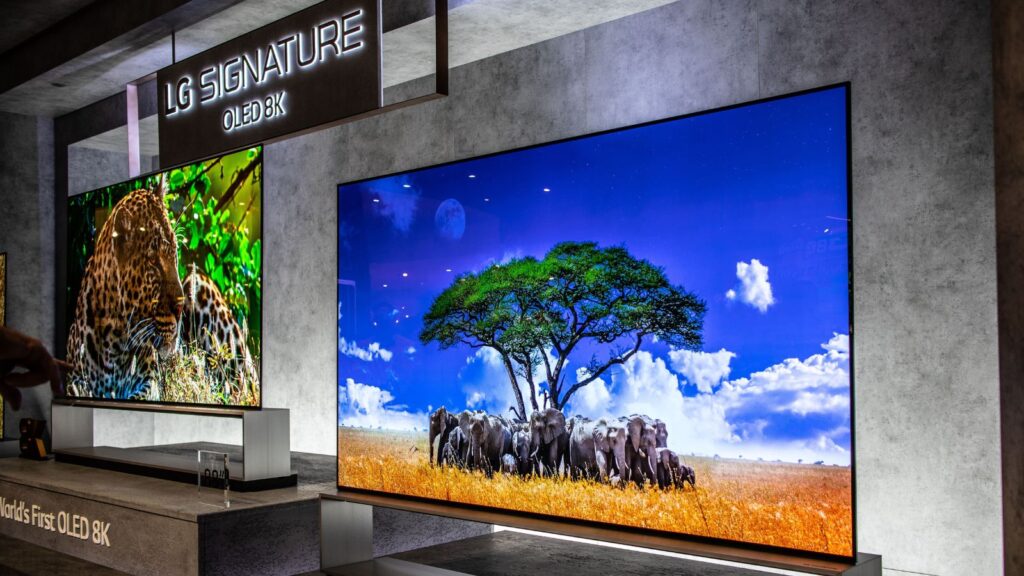
Despite the cost, OLED TVs offer clear advantages. Because each pixel emits its own light, OLED panels achieve true black levels and effectively infinite contrast. LCD TVs, even with advanced local dimming, still rely on backlights that can cause blooming or halo effects.
OLED panels also offer wider color gamuts, faster response times, and better viewing angles. Pixels can change state in as little as 0.1 milliseconds, compared to several milliseconds for LCD. That makes OLED particularly attractive for movies, sports, and gaming.
Brightness was once OLED’s biggest weakness, but newer designs like LG’s MLA-enhanced WOLED panels now reach 1,300 to 1,500 nits, narrowing the gap with high-end LCDs.
OLED isn’t for everyone, and that’s intentional
OLED remains a premium product by design. Smaller sizes under 55 inches are rare, and prices climb quickly beyond 65 inches. A 55-inch OLED might cost $1,200 to $1,800, while a comparable LCD costs under $500. At 75 inches or larger, OLED prices can jump to $3,000 to $8,000.
For a bedroom TV or casual viewing, LCD often makes more sense. OLED shines in controlled lighting environments like living rooms or home theaters, where contrast and viewing angles matter most.
There’s also usage behavior to consider. OLED panels are far more resistant to burn-in than early models, but LCD remains the safer option for TVs that stay on for hours with static content.
The bottom line
OLED TVs are expensive, not because manufacturers want higher margins, but because the technology itself resists mass commoditization.
Low yields, expensive materials, complex fabrication, blue pixel degradation, and inefficient scaling all work against price parity with LCD. Costs are falling, slowly but steadily. A 65-inch OLED panel is already hundreds of dollars cheaper to produce than it was just a few years ago.
But until manufacturing becomes simpler, materials become more stable, and yields approach LCD levels, OLED will remain a premium category.
When you buy an OLED TV, you’re not just paying for better picture quality. You’re paying for one of the most challenging consumer display technologies ever brought to market and all the invisible complexity that comes with it.
Recommended Posts:
This article was made with AI assistance and human editing.
Trending Products

iRobot Roomba Plus 405 (G181) 2in1 ...

Tipdiy Robot Vacuum and Mop Combo,4...

iRobot Roomba 104 2in1 Vacuum &...

Tikom Robot Vacuum and Mop Cleaner ...

ILIFE Robot Vacuum

T2280+T2108

ILIFE V5s Pro Robot Vacuum and Mop ...

T2353111-T2126121

Lefant Robot Vacuum Cleaner M210, W...