
For decades, screens have dictated how we work, play, and communicate. Desktops anchored us to desks. Laptops made work portable, but still demanded posture and space.
Phones shrank everything into glowing rectangles that rarely leave our hands. Now, a different idea is quietly gaining momentum. What if the screen itself disappears?
That question felt less theoretical at CES 2026, where smart glasses stopped feeling like experimental wearables and started looking like genuine screen replacements.
Across gaming, augmented reality, and everyday productivity, this year’s smart glasses revealed a shift away from novelty and toward practical, purpose-built design.
Rather than trying to do everything at once, manufacturers are focusing on solving specific problems. How do you game without neck strain? How do you work on the go without pulling out a laptop?
How do you access information without being glued to your phone? The result is a new generation of smart glasses that feel less like accessories and more like personal displays you can wear all day.
Keep reading to see how CES 2026 smart glasses could replace your TV, monitor, and even your phone.
Gaming without the physical screen
The clearest case for replacing screens comes from gaming. Asus and Xreal made that point forcefully with the ROG Xreal R1.
Built with competitive gaming in mind, it delivers a 240Hz refresh rate, the highest seen in any smart glasses so far. That alone puts it in territory normally reserved for high-end gaming monitors.
The R1 projects a massive 171-inch virtual display with 1080p resolution and HDR support.
Instead of sitting inches from a monitor, players can pin a floating screen in space and move naturally without losing alignment. A 57-degree field of view helps reduce neck strain, a subtle but important improvement for long sessions.
What makes this significant is not just performance but behavior. Gaming no longer requires a desk, a TV, or even a fixed posture.
The screen follows the user, not the other way around. That is a fundamental shift in how digital entertainment fits into physical space.
Affordable glasses that blur work and play
Not every screen replacement needs to be extreme. The Xreal 1S shows how smart glasses can quietly replace laptops and portable monitors. Priced at $449, it offers a 1200p resolution per eye with a productivity-friendly 16:10 aspect ratio and a wide 52-degree field of view.
What truly sets it apart is on-device 2D-to-3D conversion. Instead of relying on external hardware, the glasses handle processing internally, making setup simpler and more portable.
Support for devices like the Nintendo Switch 2 through the Neo Hub expands its usefulness across gaming and work.
The result is a pair of glasses that can function as a personal workstation on a plane, a portable gaming display in a hotel, or a second screen in a coffee shop. It is not trying to replace everything, but it replaces enough to change daily habits.
Cinematic visuals without the TV
If gaming proves smart glasses can replace monitors, the RayNeo Air 4 Pro argues they can replace TVs. At $299, it is one of the most affordable smart glasses at CES 2026, yet it delivers features previously reserved for premium models.
It is the world’s first HDR10-enabled smart glasses, pushing brightness up to 1200 nits while maintaining a 1080p resolution and 120Hz refresh rate. Early testers reported noticeably brighter and more vivid visuals than most previous-generation models.
Audio is handled by Bang and Olufsen-tuned speakers, reinforcing the idea that these glasses are meant for immersive viewing, not quick demos. At just 76 grams, the Air 4 Pro balances comfort and performance in a way that makes extended viewing realistic.
For users who live in small apartments, travel frequently, or simply do not want a large TV dominating their space, this kind of wearable cinema starts to make practical sense.
AI as the new invisible interface
Screens are not just about visuals. They are how we interact with information. That is where AI-focused glasses step in. The Rokid AI Glasses take a daily-task-first approach, blending lightweight hardware with AI-driven features.
Equipped with a 12MP camera, open-ear speakers, and microphones, they support real-time translation, navigation, voice interaction, and even AI-generated karaoke lyrics.
Brightness reaches 1500 nits, ensuring visibility outdoors, while a 30-degree field of view keeps information discreet rather than overwhelming.
Battery life remains a limitation, with around six hours of music playback or 45 minutes of continuous video recording, and the lack of a charging case means portability trade-offs.
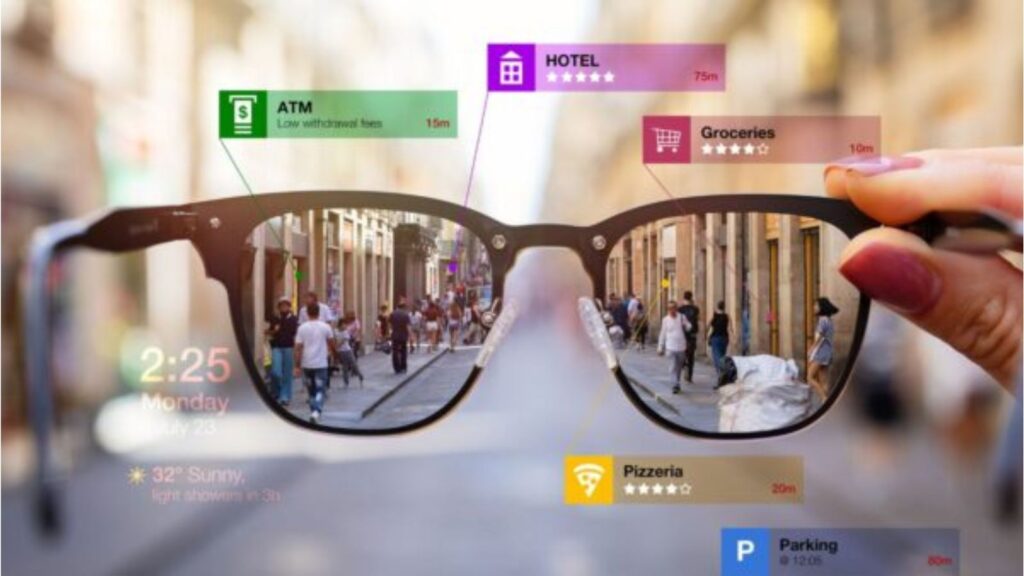
Still, the idea is clear. Instead of pulling out a phone to check directions or translate a conversation, information appears directly in your field of view.
In this model, the screen becomes contextual, appearing only when needed.
When smart glasses do not try to be everything
CES 2026 also showed that not all smart glasses need AR overlays or AI assistants to be valuable. The Povec C1 takes a completely different route. It is the world’s first electrochromic smart sunglasses, focused entirely on vision control.
Users can manually adjust lens tint in real time, switching between clear, yellow, and green across CAT 1 to CAT 3 darkness levels in just one second. Unlike photochromic lenses, the Povec C1 puts control directly in the wearer’s hands.
Designed for athletes, it features a lightweight TR90 frame, impact-resistant lenses, IP65 durability, and a battery life rated at 28 days with four hours of daily use.
There is no AR, no AI, and no notifications. Yet it still replaces something essential. The need to swap glasses, screens, or visual aids depending on lighting conditions.
It shows that screen replacement does not always mean adding more digital content. Sometimes it means removing friction from the physical world.
Productivity without the laptop
XGIMI’s MemoMind One brings another screen-free workflow into focus. Known for projectors, XGIMI entered smart glasses with a $599 device that emphasizes AI-assisted productivity.
MemoMind One supports AI note-taking, teleprompter functionality, online and offline translation, and karaoke lyrics, paired with built-in speakers and stylish frame options.
The glasses rely on a hybrid multi-LLM system combining OpenAI, Azure, and Qwen models, choosing the best model depending on the task.
Rather than replacing a phone or laptop entirely, MemoMind One reduces how often you need to look down at them. Notes, scripts, and translations appear in front of you, keeping eye contact and posture intact.
For creators, presenters, and multilingual users, that subtle shift can change how work feels.
Privacy-first glasses that fade into the background

While many smart glasses lean into cameras and sensors, the Even Realities G2 takes the opposite approach. There are no cameras and no external speakers. Privacy is the core design principle.
Information appears only when requested, displayed as a 3D floating interface with a 640 by 350 resolution and a 27.5-degree field of view. Users can activate it through touch controls, an optional smart ring, or a companion app.
Despite its minimalist hardware, the G2 supports real-time translation, transcription, teleprompter functions, and AI-assisted conversation prompts. Battery life extends up to two days, and an IP65 rating adds durability for daily wear.
This model highlights an important point. Replacing screens does not require constant visual stimulation. It requires restraint and control.
A shift from novelty to utility
Taken together, these seven smart glasses reveal a broader trend. CES 2026 was not about flashy demos or speculative futures. It was about refining smart glasses into tools people can actually live with.
Gaming-focused models replace monitors. Productivity glasses replace portable displays. AI-first designs replace phones for quick tasks. Even niche products replace specific visual tools more efficiently than traditional screens ever could.
Smart glasses are no longer trying to redefine reality. They are trying to fit into it.
As hardware improves, batteries last longer, and software becomes more context-aware, the idea of carrying multiple screens may start to feel unnecessary. The screen does not disappear. It simply moves closer, becoming personal, wearable, and optional.
Recommended Posts:
This article was made with AI assistance and human editing.
Trending Products

iRobot Roomba Plus 405 (G181) 2in1 ...

Tipdiy Robot Vacuum and Mop Combo,4...

iRobot Roomba 104 2in1 Vacuum &...

Tikom Robot Vacuum and Mop Cleaner ...

ILIFE Robot Vacuum

T2280+T2108

ILIFE V5s Pro Robot Vacuum and Mop ...

T2353111-T2126121

Lefant Robot Vacuum Cleaner M210, W...