
A growing number of Americans are discovering that a small solar panel attached to a balcony railing can lower electricity bills without the high cost of rooftop solar.
Systems once viewed as niche products in Europe are now gaining momentum in the United States as prices fall and regulations slowly become more favorable.
Plug-in balcony solar systems can range from a few hundred dollars to more than $3,000, depending on wattage, battery storage, portability, and included hardware.
What do balcony solar systems actually include?
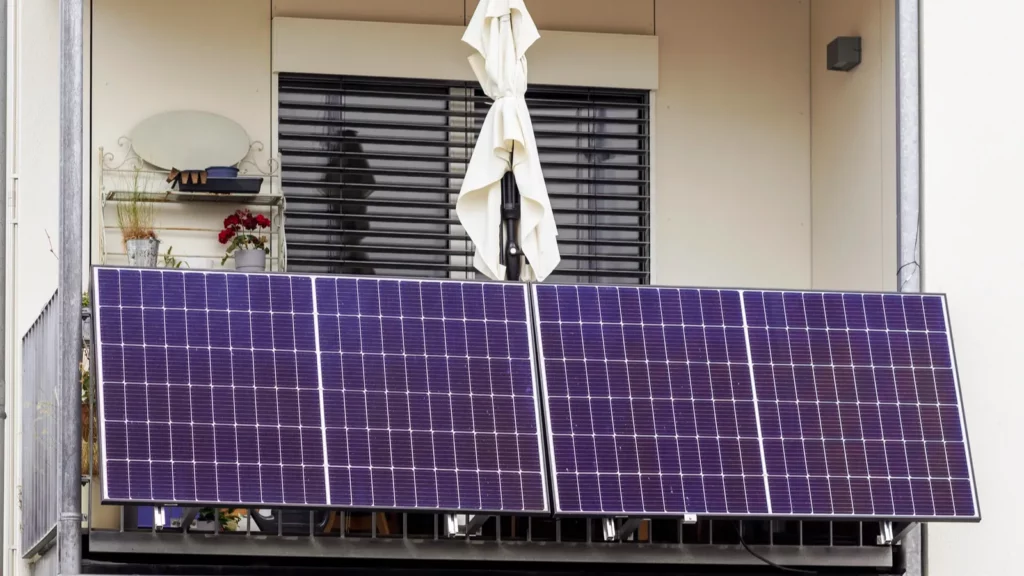
Balcony solar systems are designed to make residential solar power much closer to a consumer electronics product. Most kits include one or two solar panels, a mounting system, a microinverter, and cables that plug into a standard household outlet.
The solar panels generate direct current electricity during daylight hours. The microinverter converts that electricity into alternating current power that can be used immediately inside the home.
Many consumer plug-in solar systems are in the few-hundred-watt range, but current examples commonly fall around 400–800 watts, and Utah’s plug-in solar law covers certified devices up to 1,200 watts.
That is far less than rooftop solar systems, but enough to offset smaller daytime energy loads such as routers, televisions, lighting, laptops, and some kitchen appliances.
Why does the $1,200 price point matter?
Traditional rooftop solar systems often require major upfront investments that can reach tens of thousands of dollars before incentives. Balcony solar dramatically lowers that barrier by offering smaller systems with far lower installation costs.
A $1,200 kit may cover some complete plug-in solar setups, but exact package contents and wattage vary by brand, battery inclusion, inverter certification, mounting hardware, and shipping.
That lower entry point changes the economics of solar adoption. Instead of signing financing agreements or modifying an entire roof, consumers can experiment with solar power using a relatively small investment.
Why did Europe embrace balcony solar earlier?
Balcony solar systems have already become mainstream in parts of Europe, particularly in Germany. Apartment buildings across several European cities now feature compact solar panels attached directly to balconies and railings.
Europe benefited from clearer regulations and stronger public familiarity with small-scale renewable energy systems. Manufacturers also focused early on creating standardized plug-and-play products specifically designed for apartment living.
Little-known fact: In Germany, each 800-watt balcony system prevents roughly 310 kilograms of CO₂ emissions per year, meaning the one million systems now installed are collectively avoiding approximately 310,000 metric tons of CO₂ annually, equivalent to removing about 67,000 gasoline-powered cars.
States are beginning to loosen restrictions
Utah recently became the first state to pass comprehensive laws allowing plug-and-play solar systems up to 1,200 watts. That legislation marked a major step forward for the U.S. balcony solar market.
Other states, including Illinois, New York, Pennsylvania, Vermont, Maryland, New Hampshire, Virginia, and Minnesota, are considering reforms aimed at simplifying adoption.
Some proposals would replace lengthy pre-approval utility processes with simple notification systems. Instead of requiring formal utility authorization before installation, users may eventually only need to notify utilities after setup.
Why UL 3700 matters for plug-in solar safety
Industry organizations and testing labs are also helping expand the market. Certification programs such as UL 3700 focus on ensuring plug-and-play systems meet modern electrical safety standards.
Those certifications verify features including anti-islanding protection, safe disconnect behavior, and overcurrent protection. Utilities and regulators generally view those safeguards as essential for widespread adoption.
Despite growing momentum, rules still vary heavily by location. Some utilities continue requiring paperwork or interconnection approval for even the smallest grid-connected solar systems.
Little-known fact: The United States has an estimated 45,000 balcony and plug-in solar units installed nationwide. This equals roughly 0.03% of the 131 million U.S. households, presenting a stark contrast to Germany’s 2.67% market penetration.
Placement and sunlight matter more than many expect
Balcony solar systems perform best in areas with strong direct sunlight. South-facing and west-facing balconies generally deliver the highest production levels across most U.S. climates.
Shading can reduce output dramatically. Nearby buildings, balcony overhangs, trees, and railings may block sunlight during important production hours and lower energy generation significantly.
Panel angle also affects performance. Some mounting systems allow users to adjust tilt positions to improve solar exposure throughout the day.
Under favorable conditions, a 300 to 400-watt system may generate roughly 300 to 600 kilowatt-hours annually. That output is not enough to replace rooftop solar, but it can still offset meaningful portions of daytime electricity use.
Why are smart home users paying attention?
Balcony solar systems fit naturally into broader smart home energy trends. Many households already use smart plugs, connected thermostats, energy monitoring systems, and scheduled electric vehicle charging to reduce power costs.
Even relatively small solar systems can complement those tools effectively. Smart home users can prioritize certain activities during daylight hours when the panels are actively generating electricity.
For example, users may charge devices, run appliances, or power home office equipment while solar production is highest. That timing can help reduce expensive peak-period grid consumption.
Safety and limitations still matter
Despite increasing enthusiasm, balcony solar systems are not completely frictionless products. Buyers still need to verify local regulations, utility requirements, and building restrictions before installation.
Apartment complexes and homeowner associations may prohibit visible solar equipment or modifications to balcony railings. Some landlords may also restrict exterior installations entirely.
Safety certification remains especially important. Experts generally recommend using UL-listed inverters and approved mounting systems specifically designed for outdoor grid-connected use.

TL;DR
- Balcony solar systems costing around $1,200 are creating a lower-cost entry point into renewable energy for renters, apartment residents, and homeowners.
- Most plug-and-play systems generate between 300 and 400 watts, helping offset daytime electricity use from smaller devices and household electronics.
- States, including Utah, are changing regulations to simplify adoption, while new safety certifications help address utility and electrical concerns.
- Performance depends heavily on sunlight exposure, balcony orientation, and shading from nearby buildings, making placement critical for strong energy savings.
- Smart home users are embracing balcony solar because the systems pair naturally with energy monitoring apps, smart plugs, and time-based electricity management.
This article was made with AI assistance and human editing.
If you liked this, you might also like:
Trending Products

iRobot Roomba Plus 405 (G181) 2in1 ...

Tipdiy Robot Vacuum and Mop Combo,4...

iRobot Roomba 104 2in1 Vacuum &...

Tikom Robot Vacuum and Mop Cleaner ...

ILIFE Robot Vacuum

T2280+T2108

ILIFE V5s Pro Robot Vacuum and Mop ...

T2353111-T2126121

Lefant Robot Vacuum Cleaner M210, W...